


Explore the Giza Necropolis beyond its famous pyramids and Sphinx, with rock-cut tombs, funerary monuments, and context for its location near Cairo.
The Giza Necropolis is far more than a row of pyramids. It brings together the pyramids of Khufu, Khafre, and Menkaure, the Great Sphinx, rock-cut tombs, and other funerary monuments on Egypt’s Giza Plateau. Ancient burial grounds extend around the royal pyramids, revealing how this landscape served the dead.
If you picture the three great pyramids and the Sphinx, you already know the best-known landmarks; this guide explores what else the Giza Necropolis encompasses, where it sits in relation to Cairo, and how it fits into Egypt’s wider landscape of ancient royal cemeteries.
Key Takeaways
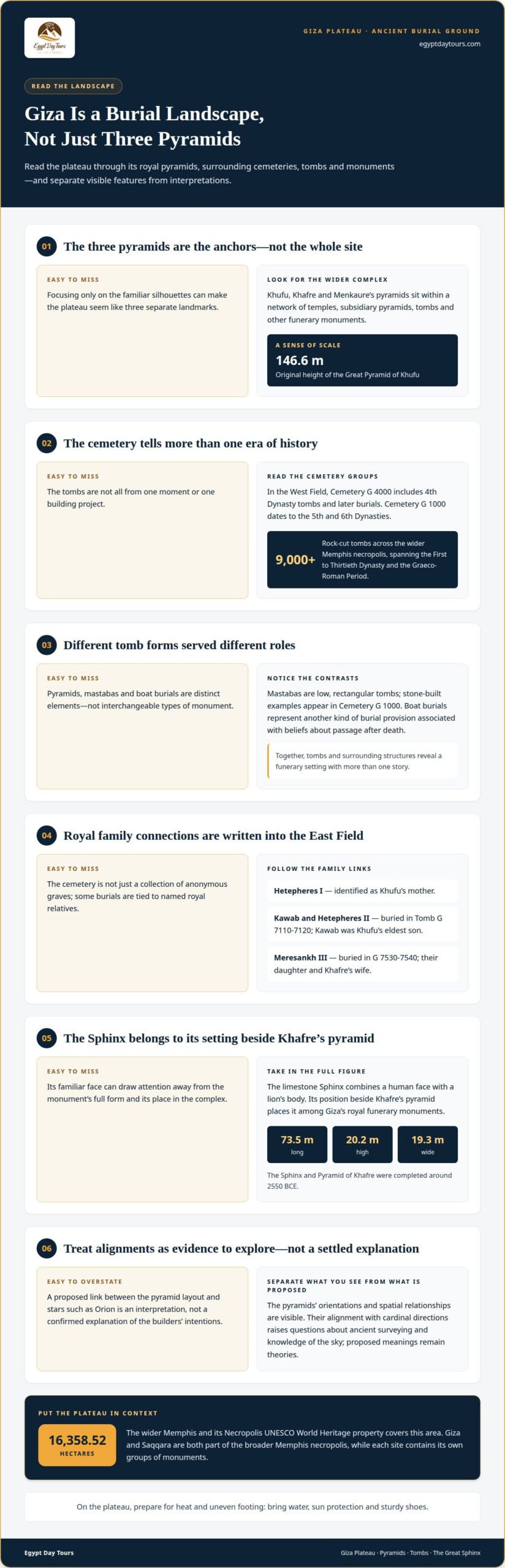
- Recognize how the three royal pyramids and the Great Sphinx anchor a much larger funerary landscape.
- Learn what the surrounding rock-cut tombs and funerary monuments can reveal about life and burial in ancient Egypt.
- Distinguish the Giza Plateau from the wider Memphis and its Necropolis UNESCO World Heritage property, which covers 16,358.52 hectares, according to UNESCO World Heritage Centre.
- Use the site’s location and scale to put its monuments in context and shape a more focused visit.
What does the Giza Complex house?
The complex includes three royal pyramids, funerary monuments, surrounding tombs, and the Great Sphinx. For the heat and uneven footing, bring water, sun protection, and sturdy shoes. Agree on the terms of any purchase or service before accepting it to avoid unwanted sales pressure.
Pyramid Alignments and Astronomical Theories
Pyramid alignments describe the structures’ orientations and spatial relationships, which are sometimes interpreted through astronomical theories. These ideas can add context as you view the monuments, while helping you distinguish visible features from proposed meanings. The pyramids’ arrangement has inspired theories linking them with stars, including Orion, but this remains an interpretation of their layout, not a confirmed explanation of the builders’ intentions. Their alignment with cardinal directions also raises questions about ancient surveying and knowledge of the sky.
Main Pyramids and Their Complexes
The three main pyramids belong to Khufu, Khafre, and Menkaure, kings of Egypt’s 4th Dynasty, dated c.2613-2494 BC. The Great Pyramid, also called the Pyramid of Khufu, is the oldest and largest. It originally stood 146.6 meters tall. Khafre’s and Menkaure’s pyramids differ in height. Their wider funerary settings include temples, smaller monuments, and subsidiary pyramids. These surrounding structures help you see the plateau as a network of royal burial places, not three isolated landmarks.
Construction and Purpose of the Pyramids
The pyramids of Giza were built as tombs for kings, joining immense construction with funerary purpose. Work on the Great Pyramid of Khufu lasted 23 years. About 100,000 large blocks were quarried each year, and each block weighed about 2.5 tons. Those figures offer a sense of the labor and planning behind the monument, without reducing its purpose to engineering alone. The tombs were part of a broader landscape devoted to royal burial and commemoration in ancient Egypt.
Builders’ Settlement and Tombs
The builders’ settlement and burial places add a human dimension to the royal monuments. The site includes a settlement described as the workers’ village, where two pyramid tombs were found. This connects the pyramids with the people involved in their construction, as well as the kings commemorated within them. As you view the plateau, consider how settlement remains and tombs sit alongside royal structures. Together, they make the complex a funerary landscape with more than one story to tell.
Rock-cut tombs and funerary monuments
Giza’s burial landscape includes rock-cut tombs, mastabas, royal graves, temples, and related structures. Alongside Saqqara, Giza forms part of the wider Memphis necropolis, which contains more than nine thousand rock-cut tombs spanning the First to Thirtieth Dynasty and the Graeco-Roman Period.
The Development of Royal Tombs
Egyptian royal tombs developed alongside changing burial customs, and Giza preserves monuments from several periods. The West Field’s Cemetery G 4000 includes tombs from the 4th Dynasty and later, while Cemetery G 1000 dates to the 5th and 6th Dynasties. These differences help you read the plateau as a changing burial ground, rather than a single building project. Antiquities here reflect generations of funerary practice.
Mastabas and Boat Burials
Mastabas are low, rectangular tomb structures, and the West Field’s Cemetery G 1000 contains stone-built examples. Their form contrasts with the pyramids, while both served funerary roles. Boat burials represent another type of burial provision associated with ancient Egyptian beliefs about passage after death. At Giza, interpret these forms as distinct elements of a larger funerary setting, not as interchangeable monuments or proof that every tomb held the same objects.
The East Field’s G 7000 cemetery group contains royal burials, including Hetepheres I, identified as Khufu’s mother. Tomb G 7110-7120 belongs to Kawab and Hetepheres II; Kawab was Khufu’s eldest son. G 7530-7540 belongs to Meresankh III, their daughter and Khafre’s wife. These named burials show how family relationships shaped the cemetery’s royal sections.
Temples connect burial places with the rituals and monuments surrounding them. At Giza, the Valley Temple and tombs add context to the pyramids, while statues and other structures mark distinct spaces within the funerary landscape. Saqqara and Giza both belong to the Memphis necropolis, but visitors encounter different groups of monuments at each site. Seeing the East and West Fields alongside the pyramid complexes gives you a clearer picture of Giza’s layered royal and non-royal burials.
The Great Sphinx
The Great Sphinx of Giza is a monumental limestone figure beside the Pyramid of Khafre. It combines a human face with a lion’s body, creating a striking guardian image on the plateau. Its position near Khafre’s pyramid visually links the Sphinx with royal funerary monuments. It is not a separate pyramid, but an essential landmark within the wider complex.
Its scale becomes clearer through its measurements: the Sphinx is 73.5 meters long, 20.2 meters high, and 19.3 meters wide. Those proportions make it easy to underestimate its size when you first see it against the surrounding landscape. Look across the full body, rather than focusing only on the face. The low, elongated form contrasts with the pyramids rising behind it.
The Pyramid of Khafre and the Great Sphinx were completed around 2550 BCE. Their close setting encourages visitors to consider how the two monuments relate, while keeping interpretation grounded in what the site shows. The Sphinx’s face and lion body have prompted questions about royal identity and symbolic meaning. Its connection to kingship and the afterlife belongs to the funerary context of Giza.
Limestone gives the Sphinx its form, and the exposed monument has changed over time. Its worn surfaces draw attention to its scale and craftsmanship, not just its familiar profile. Smaller details can be harder to distinguish from a distance. As you view it, notice how the body extends along the ground while the head rises above it.
The Sphinx is best understood as part of a larger setting, not as an isolated statue. Its proximity to Khafre’s pyramid places it among royal monuments and burial structures. The Great Sphinx remains one of Giza’s most recognizable sights, but its location adds meaning beyond its image. Seeing it beside the pyramids helps you read the plateau as a connected funerary landscape.
Location and scale of the Giza Necropolis
The Giza Necropolis is located on the Giza Plateau in Greater Cairo, Egypt. The Giza Plateau and the Giza Complex are both located southwest of Cairo. These measurements use different reference points, so the exact distance depends on where your journey begins. The complex’s coordinates are 29°58′34″N, 31°7′58″E, placing the ancient monuments within the wider metropolitan landscape.
From central Cairo, visitors can travel by taxi or ride-hailing car. The trip takes approximately 30-45 minutes, depending on traffic. That makes the Giza Necropolis accessible as a visit from the capital, though Cairo traffic can affect your travel time. The urban setting and open plateau offer a striking contrast as you approach the pyramids.
The area covered also depends on the boundary being described. The Giza pyramid complex World Heritage Site covers 16,203.36 hectares. The wider UNESCO World Heritage property of Memphis and its Necropolis covers 16,358.52 hectares, according to UNESCO World Heritage Centre. These are separate property measurements, not estimates of the pyramid monuments alone.
The wider Memphis landscape includes Giza and ancient burial grounds such as Saqqara. Giza’s pyramids are associated with Egypt’s 4th Dynasty, while the broader necropolis contains archaeological sites from different periods. Memphis is traditionally believed to have been founded around 3000 BC as the capital of a politically unified Egypt. This larger context explains why the Giza Necropolis belongs to a heritage landscape extending beyond its famous skyline.
For your visit, distinguish the Giza Plateau from the wider Memphis and its Necropolis property. The Pyramid of Khafre, the Great Sphinx, and nearby monuments define the Giza setting. Saqqara belongs to the broader historical landscape, not to the immediate group of monuments on the plateau. Keeping these boundaries clear helps you understand what you’re seeing and how the Giza Necropolis fits into Egypt’s wider archaeological geography.
Egypt Day Tours
Egypt Day Tours can help travelers turn what they’ve learned about the Giza Plateau into a well-planned itinerary. Their Giza pyramids tours connect the monuments with the questions that bring them into context, from royal burial grounds to the relationship between the pyramids and the Sphinx. Choose a Cairo tour to build a wider day around the capital, or consider Luxor and Aswan tours if your travel plans include other ancient sites. The right fit depends on what you want to see and how you’d like your days arranged. Share your interests, whether it’s the plateau’s scale, its tombs, or its famous landmarks, and contact Egypt Day Tours to discuss your upcoming Egyptian adventure.
Choose the Egypt journey that fits you
Your visit to the Giza Necropolis can be a focused day among ancient monuments or one part of a longer journey through Egypt. Let the site shape your interests, then decide whether you’d like to explore more of Cairo or continue to another historic destination. As a licensed Egyptian tour operator, Egypt Day Tours offers Cairo tours, Giza Pyramids tours, and Luxor tours, giving you options to build a route around the places that matter most to you. As you plan your time at the Giza Necropolis, consider what you most want to notice, from the plateau’s scale to its burial landscape. The Giza Necropolis can be a memorable starting point for a wider Egypt itinerary. Share your interests and preferred pace, then contact Egypt Day Tours to plan your visit. Your journey can begin with one landmark and unfold at your pace.
Frequently Asked Questions
What is in the Giza Necropolis?
The Giza Necropolis includes royal pyramids, the Great Sphinx, temples, cemeteries, and smaller funerary monuments. The West Field and East Field extend the burial landscape beyond the pyramid area, with tombs associated with royal families and officials. On a visit, these distinct zones help you look beyond the famous skyline and notice how burial places and ceremonial structures are arranged across the plateau.
What is the Giza Necropolis and what monuments are included?
The Giza Necropolis is an ancient burial landscape on the Giza Plateau, not just a name for the three pyramids. Its best-known monuments are the pyramids of Khufu, Khafre, and Menkaure, alongside the Great Sphinx. The wider complex also includes temples, subsidiary pyramids, mastabas, and cemetery fields. This broader definition helps distinguish the central landmarks from the surrounding archaeological areas.
When were the pyramids and other monuments at Giza built, and by whom?
The main pyramids were built as royal tombs for kings of Egypt’s 4th Dynasty, dated c.2613-2494 BC. The Great Pyramid was built for Khufu, and Menkaure’s pyramid dates to around 2510 BCE. The Pyramid of Khafre and the Great Sphinx were completed around 2550 BCE. These monuments reflect royal building projects, while nearby tombs belong to other people and periods.
What are the dimensions and historical significance of the Great Pyramid of Giza?
The Great Pyramid was originally 146.6 meters tall and is the oldest and largest of Giza’s three pyramids. It was built for King Khufu and is the only surviving monument of the Seven Wonders of the Ancient World. Its height remained unmatched for about 3,800 years. These details help explain why the structure stands apart, even within a plateau known for monumental royal tombs.
What are the main tombs, temples, and archaeological sites in the Giza Necropolis?
Key areas include the East Field, West Field, and Central Field cemeteries, along with the Valley Temple and royal pyramid complexes. Named tombs include vizier Hemiunu’s tomb in Cemetery G 4000 and Meresankh III’s tomb, G 7530-7540. The East Field also contains royal burials associated with Hetepheres I. These places give you specific names and locations to look for beyond the pyramids.
What are the opening hours for the Giza Necropolis?
The Giza Complex is open daily from 8 a.m. to 5 p.m., with last entry at 4 p.m. Check current visitor information when planning your visit, and allow enough time to enter before last entry. If you’re combining the plateau with another destination, account for travel time as well as time at the monuments.
A licensed Egyptian tour operator planning private trips since 2013, with licensed Egyptologist guides on every tour.
5.0 on TripAdvisor · 1,050+ reviews