


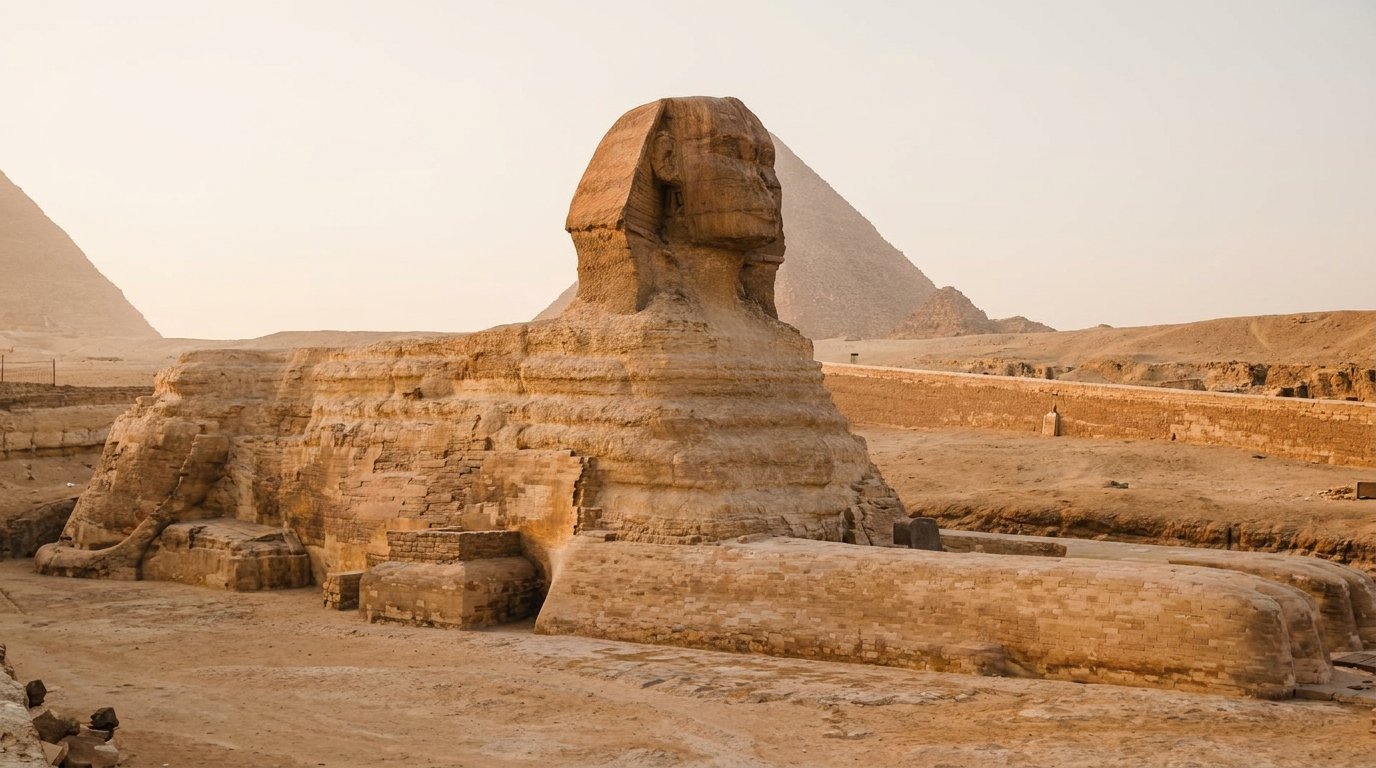
Explore sphinx egypt: learn the Great Sphinx of Giza’s history, location, debated origins, and restoration efforts to preserve this ancient landmark today.
The sphinx in Egypt best known around the world is the Great Sphinx of Giza, a colossal limestone statue with a human head and a lion’s body, carved from bedrock beside the pyramids. It stands 20 metres (66 feet) high and is generally believed to have been made during the 4th Dynasty, around 2500 BCE, although the identity of the ruler it represents remains debated. Its weathered face and monumental scale invite questions about what a sphinx meant to ancient Egyptians, how this one was built, and whether its features are male or female.
If you’re picturing a familiar mythical creature, the sphinx in Egypt has its own story: it combines a king’s human face with a lion’s powerful body. This guide explains where the Great Sphinx stands, how it was carved from limestone bedrock, and why researchers associate it with King Khafre while recognizing that its origins remain debated.
You’ll also learn how wind, sand, and other factors have contributed to the monument’s deterioration, and how excavation and restoration have helped preserve it. Together, these details offer a clearer view of the Sphinx as both a remarkable work of ancient craftsmanship and a defining part of a visit to the Giza plateau.
Key Takeaways
- Learn how builders shaped the monument from the natural rock and what clues link its construction to Khafre.
- Place the Sphinx within the Giza Plateau and understand how it relates to nearby temples and pyramids.
- Understand why the Sphinx is portrayed as male and why alternative ideas about its identity and age remain debated.
- See how exposure and changing site conditions have affected the monument, and how excavation and restoration have addressed its deterioration.
The Sphinx’s construction during the 4th Dynasty
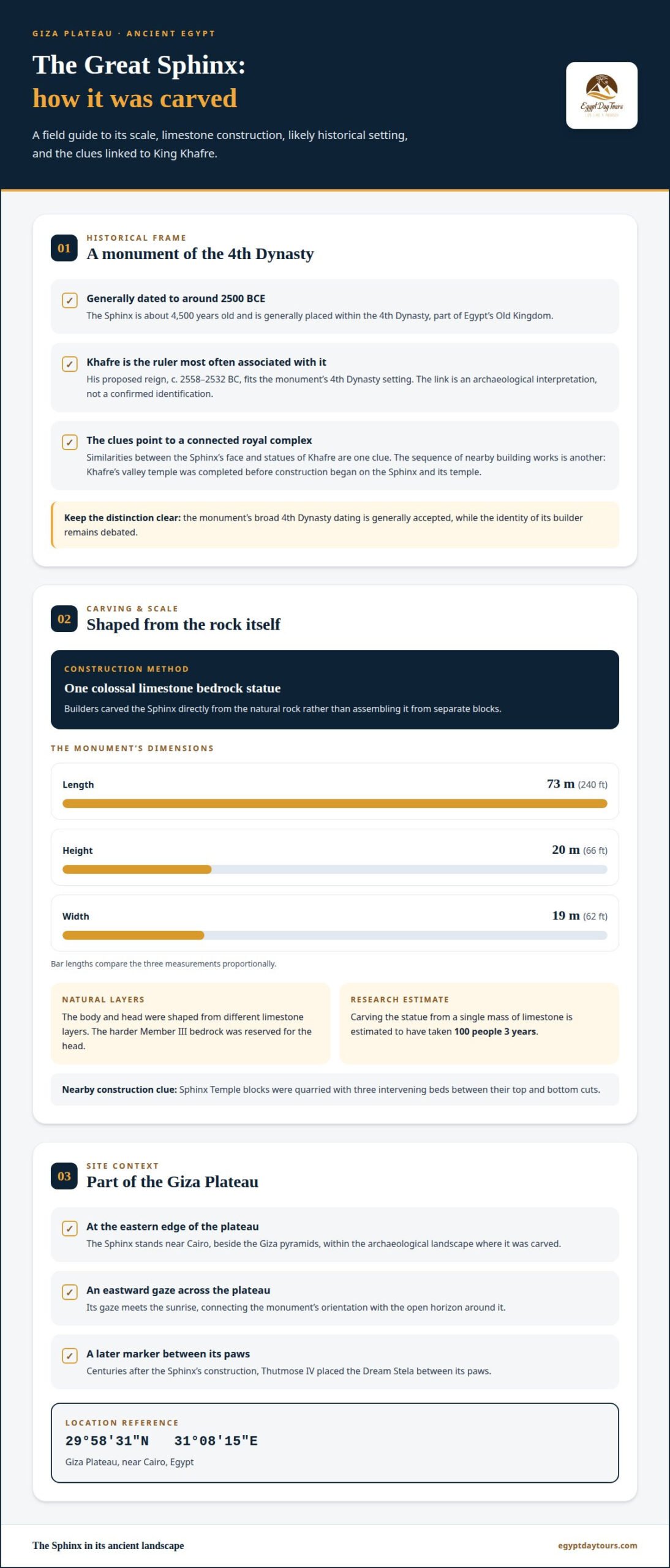
The Great Sphinx is about 4,500 years old, carved from limestone bedrock during Egypt’s 4th Dynasty. Its builder is unknown, but archaeological evidence points toward construction during King Khafre’s reign.
Construction Date and Old Kingdom History
The Sphinx belongs to the Old Kingdom, a period dated from about 2613 to 2181 B.C. Its construction is generally placed around 2500 BCE, within the 4th Dynasty, dated c.2613-2494 BC. This places the monument among the major royal projects of ancient Egypt’s pyramid-building era. For visitors, that timeline connects the Sphinx’s history with the nearby great pyramid and the wider Giza landscape. The statue’s eastward gaze also meets the sunrise over the plateau, giving its setting a striking horizon.
Possible Construction Under King Khafre
Khafre is the king most often linked to the Sphinx, though his role remains a scholarly interpretation. The proposed reign dates, c.2558-2532 BC, fit the monument’s 4th Dynasty setting. Archaeological analysis found similarities between the Sphinx’s face and statues of Khafre, while the order of nearby building works offers another clue. Khafre’s valley temple was completed before construction began on the Sphinx and its temple. The sequence places the monument within a connected royal complex, but does not establish its builder with certainty. Centuries later, Thutmose IV placed the Dream Stela between the Sphinx’s paws.
Limestone Construction and Dimensions
The Sphinx is a colossal statue carved directly from limestone bedrock, rather than assembled from separate blocks. Its body and head were shaped from different natural layers; 4th Dynasty builders reserved harder Member III bedrock for the head. The monument measures 73 metres (240 feet) long, 20 metres (66 feet) high, and 19 metres (62 feet) wide. Those dimensions help explain the scale of the undertaking. Researchers estimate that carving the statue from a single mass of limestone would have taken 100 people 3 years. Nearby Sphinx Temple blocks were quarried with three intervening beds between their top and bottom cuts.
Where is the Great Sphinx Located?
The Great Sphinx is on the Giza Plateau, near Cairo, at 29°58′31″N 31°08′15″E. For visitors, this places the Sphinx in Egypt within a broad archaeological landscape, rather than inside a museum or separate display.
Location on the Giza Plateau
The Great Sphinx in Egypt stands at the eastern edge of the Giza Plateau. Its coordinates give you a precise reference point, while the open plateau helps orient the visit among the ancient sites. A 1904 aerial photograph shows the Sphinx within this wider setting. That view makes clear that its location is part of the experience: the monument is encountered in the landscape where it has stood, not in a gallery removed from its surroundings.
Proximity to the Giza Pyramids
The Sphinx stands beside the Giza pyramids, so you can see both landmarks during the same visit to the plateau. Its position makes it easy to understand how the Sphinx of Giza fits into the wider site. The surrounding ground and open sightlines reveal its relationship to nearby monuments without relying on a museum map. Egypt’s Sphinx is a prominent feature of the plateau and a natural stop while exploring Giza.
From Cairo, travel to the Giza Plateau to reach the site. Excavation has helped reveal the arrangement of structures across this archaeological area, while the 1904 aerial photograph offers an early overhead record. These views provide different ways to understand where the Sphinx sits: one from the ground, among the monuments, and one from above.
Access arrangements can vary, so check the current site arrangements before planning a visit. In its outdoor setting, you encounter the carved monument in place, with the plateau forming part of the experience. Check the current site arrangements as you plan your day.
Is the Great Sphinx male or female?
The Great Sphinx is generally understood to depict a male king with a lion’s body. Ancient Egyptian sphinxes used this human-and-lion form to express royal power. Its gender reflects its traditional royal role, even though its precise identity and date remain debated.
Khafre is the ruler most commonly associated with the monument, but other proposals place it elsewhere in Egypt’s royal history. One proposed date connects the Sphinx to Amenemhat II, whose reign is given as around 1929 to 1895 B.C. Another theory suggests construction occurred seven centuries after Khafre’s reign. These alternatives show why the Sphinx’s appearance alone cannot identify its builder or date.
Some arguments rely on erosion patterns to suggest a much earlier origin, before 7000 BCE. Most experts dismiss that proposal. It differs sharply from the conventional 4th Dynasty interpretation, which places the statue within the period of Giza’s royal monuments. The distinction matters: a claim about age needs support from archaeological context, not just an interpretation of weathering.
Atlantis and ancient-astronaut theories also appear in popular discussions of the Sphinx’s origins. These are speculative ideas, not established archaeological explanations of who carved the statue. Its location beside the valley temple and pyramid complex provides a tangible historical context; claims about lost civilizations or visitors from space are not supported by comparable archaeological evidence.
The clearest distinction is between what the monument depicts and what remains uncertain. Its traditional form is a male royal figure, while the link to Khafre and the exact date are interpretations assessed against archaeological evidence. Thutmose IV’s Dream Stela, placed between the Sphinx’s paws, shows that later Egyptians also associated the ancient statue with kingship and divine authority.
Restoration and deterioration of the Sphinx
The Great Sphinx’s limestone has weathered under exposure to wind, rain, and sand. Preservation efforts have included excavation, repairs, and ongoing study of the monument’s condition.
The missing nose has a long history of speculation. Frederik Louis Norden’s drawings from 1737 already show the Sphinx without it, disproving the story that Napoleon’s troops damaged it with cannonfire in 1798. Al-Maqrīzī attributed the damage to Muhammad Sa’im al-Dahr in 1378. These accounts show why historical evidence matters when separating documented events from later stories.
Excavation and restoration have unfolded over centuries. Émile Baraize carried out work around 1926, and restoration efforts have continued since the mid-1900s. The goal is to preserve surviving limestone, not recreate details lost to time. In 1931-1932, workers dismantled the Roman stairway beside the Sphinx, changing part of the monument’s later built surroundings.
Conservation also depends on recording the stone’s condition. The 1979-1983 ARCE Sphinx project produced hundreds of maps and thousands of drawings. This documentation helps researchers compare features and understand how the exposed surface changes. It also supports careful decisions about repairs, since the Sphinx was carved from natural bedrock rather than assembled from replaceable blocks.
Water posed another concern near the plateau. In 2007, authorities found that the local water table beneath the Sphinx was rising because sewage was being dumped in a nearby canal. Moisture can threaten porous limestone, so tracking water conditions matters alongside visible surface repairs. The Sphinx’s valley setting and nearby causeway form part of the wider archaeological landscape around the monument.
Smog and airborne pollution can affect exposed stone, while the documented preservation record also highlights weathering, sand, and water. To experience the monument in its setting, plan a visit to Giza.
Egypt Day Tours
Egypt Day Tours can help you plan a visit that places the Great Sphinx in the wider story of Giza. A Giza pyramids tour links the statue with nearby monuments, while a Cairo tour can include the plateau in a broader itinerary. This is useful if you want more context than a brief stop or are planning a day focused on ancient history.
Choose a pace and focus that suit your plans. You could center your visit on the Sphinx and pyramids or include Giza as part of a wider Cairo experience. Egypt Day Tours offers private tours guided by licensed Egyptologists, who provide historical context for the landscape and its monuments.
Contact Egypt Day Tours to discuss a visit that fits your interests.
Let Your Giza Visit Shape What Comes Next
Seeing the Sphinx in Egypt can be more than a landmark stop. Let the visit shape how you spend the rest of your time: linger among the monuments, explore more of Cairo, or continue south to Upper Egypt. A thoughtfully planned itinerary gives you room to follow your interests, whether ancient history is your main focus or one part of a wider journey.
Egypt Day Tours offers Cairo tours, Giza pyramids tours, and Luxor tours, all guided by licensed Egyptologists who bring historical context to the places you visit. Shape your plans around the sites that matter to you and a pace that suits your travel party. This flexibility helps connect Giza with other destinations while giving each day its own character.
If you’re ready to turn your interest in the Great Sphinx into a personal Egypt itinerary, contact Egypt Day Tours to plan your visit. Let the next part of your journey take shape around what inspires you.
Frequently Asked Questions
What Is a Sphinx?
A sphinx is a mythical creature, often shown with a human head and a lion’s body. The Egyptian form is distinct from the Greek tradition, which arose about 2,000 years after the Great Sphinx was built. That difference helps explain why the same word can describe figures with different cultural meanings. At Giza, the form connects the monument to ancient Egyptian ideas of kingship.
Did Napoleon shoot the nose off the Sphinx?
No. Napoleon’s troops did not destroy the Sphinx’s nose during the 1798 campaign. The nose was already missing in earlier depictions. A separate detail visitors may notice is the monument’s beard: surviving fragments are dated to the 14th century BC. The beard fragments and missing nose are distinct features, each with its own history and evidence.
Which pharaoh is the Great Sphinx Associated with?
The Great Sphinx is most commonly associated with King Khafre, although this attribution remains debated. A later royal connection appears in the Dream Stela of Thutmose IV, set between the Sphinx’s paws. The inscription recounts a divine message promising Thutmose kingship if he cleared sand from the monument. It reflects a later religious meaning, rather than identifying the original builder.
What is the Great Sphinx of Giza?
The Great Sphinx of Giza is an ancient Egyptian monument carved in the form of a human head and lion’s body. It is described as the oldest colossal statue of its kind. Its scale and form make it distinct from smaller sphinx sculptures, while its position among Giza’s royal monuments helps visitors read it as part of an ancient ceremonial landscape.
What are the dimensions of the Great Sphinx?
The Great Sphinx measures 73 metres (240 feet) long, 20 metres (66 feet) high, and 19 metres (62 feet) wide. These measurements describe its overall length, height, and width. For a practical visual reference, its length runs from the head toward the body’s rear, while its height rises above the surrounding plateau. The figures convey the scale of the carved monument.
Where is the Sphinx located in Egypt?
The Sphinx is on the Giza Plateau, near Cairo, at 29°58′31″N 31°08′15″E. Its location is useful to keep in mind when planning a Giza visit: the Sphinx stands within the plateau’s archaeological site, not in a separate museum. The nearby pyramid complex forms part of the same landscape, so visitors can experience the monuments together during a visit.
A licensed Egyptian tour operator planning private trips since 2013, with licensed Egyptologist guides on every tour.
5.0 on TripAdvisor · 1,050+ reviews