


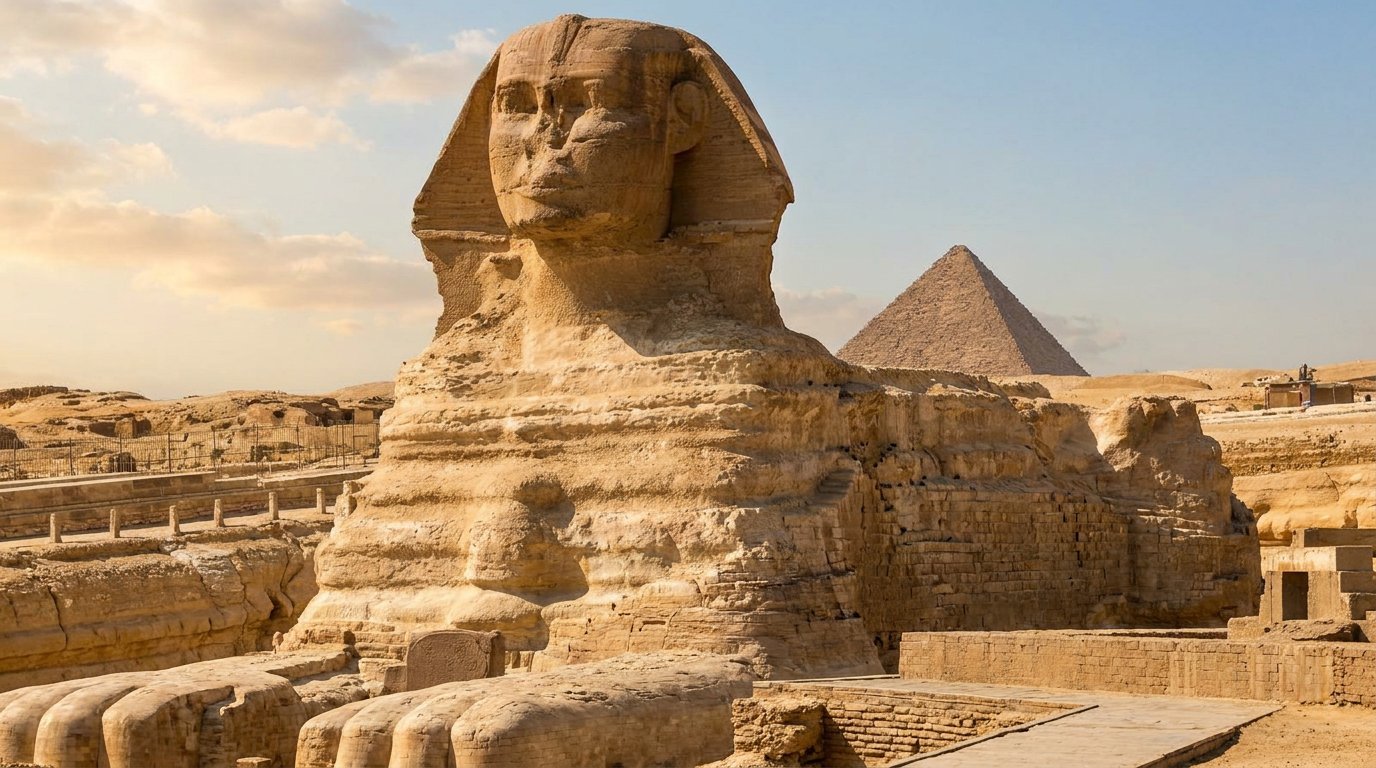
Discover what the great sphinx of giza represents, where it stands, and why the Napoleon nose story is disputed, plus its links to Khafre and ancient Egypt.
In ancient Egyptian art, a sphinx joined a king’s human identity with a lion’s body, a form that expressed royal authority and strength. The Great Sphinx stands beside the pyramids at Giza, a limestone monument generally believed to date to around 2500 BCE.
Measuring 20 metres (66 feet) high and 73 metres (240 feet) long, it carries a name with its own history: Horemakhet, meaning “Horus in the Horizon,” reflecting a later religious role associated with the sun god.
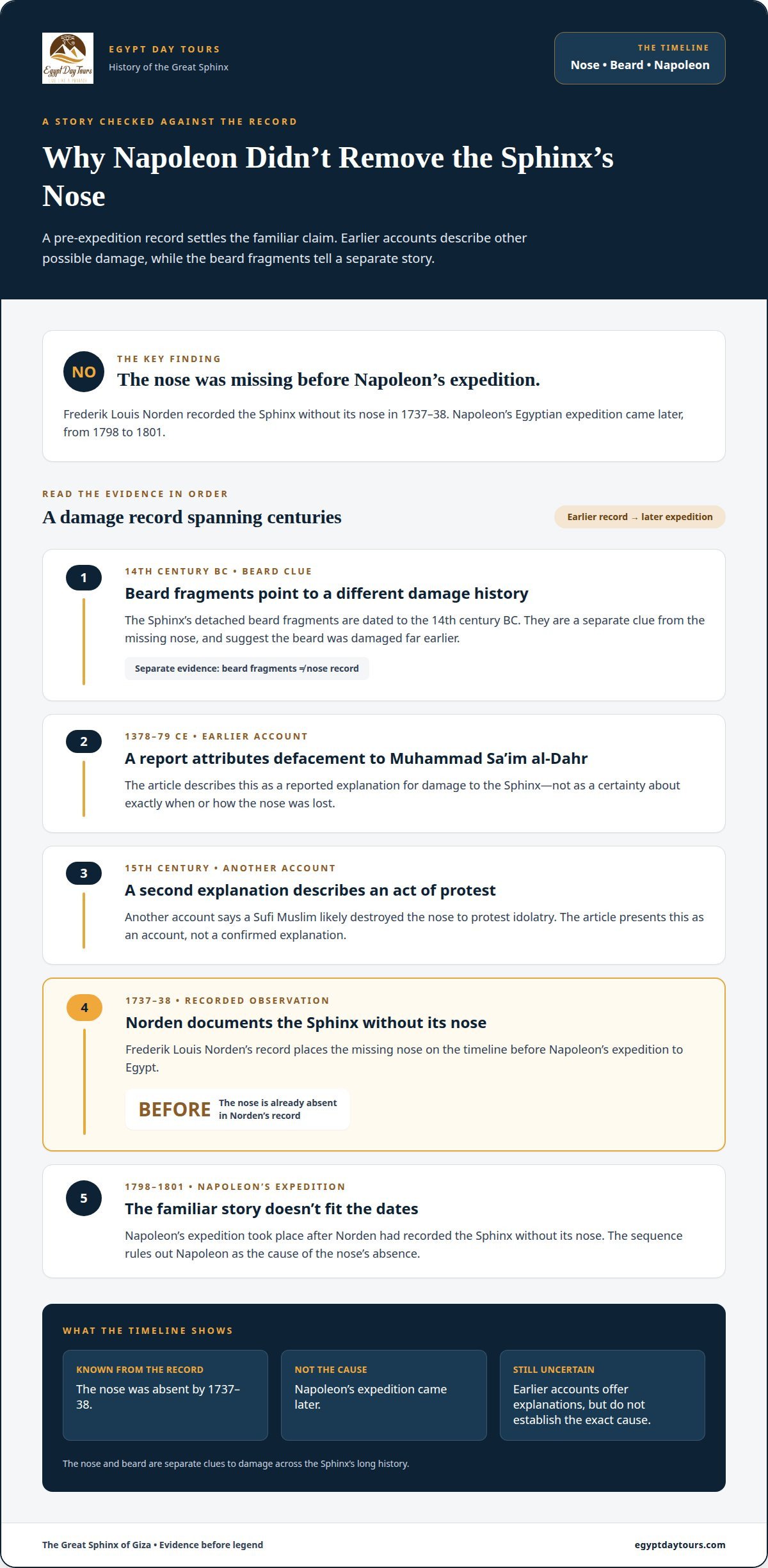
Its missing nose has inspired a familiar story about Napoleon, but Frederik Louis Norden recorded the Sphinx without it in 1737-38, before Napoleon’s Egyptian expedition of 1798-1801, placing the damage earlier than the legend suggests.
Key Takeaways
- Learn what the sphinx form represented in ancient Egypt and how it differs from the familiar Greek image.
- See why the timeline of the missing nose challenges the story that Napoleon’s troops caused the damage.
- Understand how excavation and restoration work revealed more of the monument and shaped what visitors see today.
- Explore the Sphinx’s connection to Giza, Khafre, and the ancient name Horemakhet.
Did Napoleon shoot the nose off the Sphinx?
No. The Great Sphinx of Giza had already lost its nose before Napoleon’s expedition to Egypt, so the familiar story does not fit the timeline. The nose and beard have a longer, less certain history of damage.
Damage to the Nose and Beard
The missing nose and detached beard fragments are separate clues to damage across the monument’s long history. Frederik Louis Norden recorded the Sphinx without its nose in 1737-38. The beard fragments are dated to the 14th century BC, suggesting the beard was damaged far earlier. These details help you distinguish what survives on the statue from later stories about its face.
The Napoleon Nose Myth
The Napoleon myth attributes the missing nose to his forces during their Egyptian campaign. But Norden’s observation came before that expedition, which took place from 1798 to 1801. The sequence rules out Napoleon as the cause of the nose’s absence, even if the tale remains familiar beside the pyramid and temple complex.
Earlier accounts offer different explanations for the damage. The Sphinx was reportedly defaced by Muhammad Sa’im al-Dahr in 1378-79 CE. Another account says a Sufi Muslim likely destroyed the nose in the 15th century to protest idolatry. These claims point to human damage, but they do not make the Napoleon story accurate.
The Great Sphinx of Giza also bears marks of age and restoration, so its present appearance does not record every event in its history. Its headdress remains recognizable, while the missing nose changes the balance of its face. In ancient Egypt, a royal figure with a lion’s body symbolized power; damage to its features shapes how visitors read that image today.
Look closely at the front paws, too. Thutmose IV later placed the Dream Stela between them, linking the monument to a royal story from another period. The Sphinx was once buried in sand, and exposure and restoration have shaped what visitors see today. Its missing nose has no direct connection to Napoleon, while the surviving stone preserves traces of a much longer history.
Is the Great Sphinx male or female?
Ancient Egyptian sphinxes represented kings with lion bodies, so the Great Sphinx is understood as a male royal figure. The statue is 20 metres (66 feet) high and 73 metres (240 feet) long. Check access arrangements before visiting, and allow time to take in the surrounding monuments.
Excavation has been a long process because sand repeatedly covered much of the statue. The Sphinx remained buried up to its shoulders until the early 1800s. Earlier attempts to clear it did not reveal the whole monument, leaving its scale and condition difficult to assess from the ground.
In 1817, Giovanni Battista Caviglia led a modern excavation that uncovered the Sphinx’s chest completely. Capt. Caviglia attempted the work with a team of 160 men, but the effort did not finish uncovering the entire statue. The excavation was not fully completed until about 1936, more than a century later.
That long timeline matters when you picture the Sphinx today. Its exposed body and visible features reflect repeated excavation, not a single moment of discovery. Excavation records and restoration work help explain how the monument’s appearance changed over time, even as its massive form remained beside Giza’s other ancient landmarks.
A photograph documents Émile Baraize’s excavation and restoration work around 1926. Restoration efforts continued from the mid-1900s onward, as specialists worked to preserve the limestone statue. Some restoration attempts in the 1980s caused further harm, showing how difficult it can be to protect an ancient monument while repairing earlier damage.
The surrounding Giza complex adds context. Archaeological analysis indicates that Khafre’s valley temple was completed before construction began on the Sphinx and its temple. This sequence places the statue within a broader landscape of buildings, while ongoing restoration reminds you that its story includes both ancient construction and modern preservation.
Where is the Great Sphinx Located?
The Great Sphinx stands on the Giza Plateau in Giza, Egypt, beside the pyramids. The plateau lies west of the Nile, placing the statue in a landscape shaped by royal tombs and temples. Its setting connects the Sphinx to the wider Giza complex, rather than making it an isolated monument.
Khafre is the pharaoh most often associated with the Sphinx. His reign is dated approximately 2558-2532 BC, and the statue is thought to have been carved during his rule. The Sphinx belongs to Egypt’s Fourth Dynasty, dated approximately 2613-2494 BC. These dates place the monument within the Old Kingdom.
The connection to Khafre rests on several lines of evidence, not a surviving inscription that names him as the builder. Archaeological analysis indicates that Khafre’s valley temple was completed before work began on the Sphinx and its temple. This sequence places the statue within a planned complex of royal monuments at Giza.
Facial comparisons provide another clue. Analysis found striking similarities between the Sphinx’s features and those of statues of Khafre. This resemblance supports the traditional attribution, but it suggests an association rather than directly identifying the sculptor. The distinction helps explain why researchers connect the limestone figure with Khafre while remaining careful about what the evidence establishes.
The Great Pyramid of Giza and Khafre’s pyramid help orient you on the plateau. The Sphinx lies near Khafre’s pyramid complex, where temples and the valley route form part of the same monumental setting. Visiting the area lets you see the relationship in the landscape: royal architecture, carved limestone, and the nearby Nile valley all form part of Giza’s ancient context.
The Sphinx’s name and its role in ancient Egypt
The ancient Egyptian Sphinx joined a king’s human identity with a lion’s body. That sculpture expressed royal power through a form that was both human and animal. The word “sphinx,” however, comes from Greek mythology and arose about 2,000 years after the monument was built. The familiar Greek name therefore doesn’t explain what the figure meant to Egyptians.
Ancient Egyptians called the Great Sphinx Horemakhet, meaning “Horus in the Horizon.” The name connects the monument with the sun and horizon, fitting for a statue facing east toward the rising sun. In this Egyptian context, the Sphinx was more than a monumental sculpture beside the Great Pyramid. Its identity joined kingship with a divine solar presence.
By about 1500 BCE, the Sphinx had gained a religious role associated with Horemakhet and was believed to act as an oracle. During Egypt’s 18th Dynasty, dated approximately 1550-1295 BC, it was regarded as a manifestation of the sun god. These beliefs show how the meaning of an ancient monument could develop long after its construction, linking the old statue with later religious practice.
Nearby temples and royal monuments show how the Sphinx’s role developed over time. Amenhotep II built a temple beside it and dedicated the temple to Horemakhet. Later, Thutmose IV erected the Dream Stela between the statue’s front paws. Its placement connected a royal account with the monument, making the space between the paws a setting for a story about divine favor and kingship.
The missing nose may catch your attention first, but the name and nearby stela offer a deeper way to understand the site. Horemakhet identifies the Sphinx through its Egyptian religious meaning, while the Greek term belongs to a much later tradition. Together, these details show why the monument’s role cannot be reduced to its face or its proximity to the pyramids.
Egypt Day Tours
Egypt Day Tours’ private Giza Pyramids tours help place the Sphinx within the wider story of Giza. A visit brings the nearby pyramids, temples, and royal landscape into focus, adding context to the monument’s name and ancient role. Choose a guided tour to connect the history you’ve explored with the site itself, at a pace suited to your interests.
Egypt Day Tours also offers tours in Cairo, Luxor, and Aswan, giving you room to shape a wider journey around the places that interest you. Whether your plans center on Giza or include other historic settings, your private itinerary can be tailored to your travel preferences.
Contact Egypt Day Tours to discuss a visit to Giza.
Plan a visit that fits your interests
Seeing the great sphinx of giza in person can turn your curiosity about ancient Egypt into a lasting connection with its landscape. Take time to notice the details, absorb the setting, and follow the stories that interest you most.
Egypt Day Tours’ licensed Egyptologist guides bring specialist knowledge to your visit while keeping the experience centered on your interests. Their expertise can help connect the monument’s surroundings with its history.
Whenever you’re ready to shape your plans, contact Egypt Day Tours for your visit. Let your curiosity guide the next step.
Frequently Asked Questions
What Is a Sphinx?
A sphinx’s form and meaning depend on the culture that created it. Egyptian examples served as royal imagery, while Greek mythology developed a different sphinx with its own stories. This distinction helps you understand the Giza monument through ancient Egyptian beliefs, rather than applying later Greek legends to its original setting.
Which pharaoh is the Great Sphinx Associated with?
The Great Sphinx is most commonly associated with Pharaoh Khafre. The attribution connects the monument to the royal complex around his pyramid, rather than identifying the individual people who carved it. Khafre’s pyramid is about 10 feet shorter than the Great Pyramid, a useful comparison when viewing the two structures together on the Giza Plateau.
What is the Great Sphinx of Giza and when was it built?
It is a monumental ancient Egyptian statue carved from limestone at Giza, generally believed to date to around 2500 BCE. Its dimensions give a fuller sense of its scale: the Sphinx is 19 metres (62 feet) wide, in addition to its great length and height. Its position among Giza’s monuments places it within a wider royal landscape.
Who built the Great Sphinx and which pharaoh does it depict?
The Sphinx is traditionally linked to Khafre, but that association does not identify the individual carvers. Ancient Egyptian monuments involved skilled planning and stonework; the surviving evidence here points to a royal connection, not named sculptors. Keep the distinction in mind: Khafre is the pharaoh associated with the statue, while its makers remain unidentified.
What is the Great Sphinx made of, and how was it carved?
The Sphinx was carved from limestone, shaped directly from a single mass of bedrock rather than assembled from separate statue blocks. Researchers estimate that carving the monument could have taken 100 people 3 years. That estimate gives you a sense of the scale of the undertaking, while the stone’s original form helped determine the statue’s overall shape.
What does the Great Sphinx symbolize in ancient Egyptian culture?
The Sphinx brings royal authority and the lion’s strength together in a single image. Its cultural meaning also developed beyond kingship: Egyptians later associated the monument with solar worship and Horemakhet. These layers help explain why it was more than a royal sculpture. Its place in religious belief gave the ancient statue continuing significance across different periods of Egyptian history.
A licensed Egyptian tour operator planning private trips since 2013, with licensed Egyptologist guides on every tour.
5.0 on TripAdvisor · 1,050+ reviews